The term Hollywood Smile is commonly used to describe a brighter, more even and visually harmonious smile. However, it is not a single dental procedure and it should not automatically mean placing crowns on every visible tooth.
Depending on the patient, a Hollywood Smile may involve professional whitening, composite bonding, orthodontic alignment, porcelain veneers, ceramic crowns, gum contouring or a combination of several treatments.
The most appropriate plan depends on the condition of the teeth, enamel, gums, bite, facial proportions and the patient’s expectations.
For international patients considering a Hollywood Smile in Turkey, the central question should not be how many teeth can be covered in the shortest time. It should be which treatment can achieve a natural result while preserving as much healthy tooth structure as possible.
What Is a Hollywood Smile?
A Hollywood Smile is a popular non-clinical expression for an aesthetic smile transformation.
Patients often use the term when they want to improve:
tooth colour
tooth shape
tooth length
visible gaps
chipped edges
mild crowding
uneven tooth proportions
asymmetry
worn teeth
old fillings or restorations
the relationship between teeth, lips and face
There is no universal Hollywood Smile design.
A smile that looks natural on one person may appear too white, too large or too symmetrical on another.
An appropriate smile design should consider:
facial shape
lip movement
gum display
tooth width and length
tooth colour
age
bite
jaw position
speech
personality and aesthetic preferences
The aim should be harmony rather than copying a standard set of teeth.
Is Hollywood Smile a Treatment or a Marketing Term?
Hollywood Smile is mainly a marketing and patient-language term rather than a formal dental diagnosis.
The actual dental treatments may include:
bleaching
composite bonding
veneers
crowns
orthodontics
gum treatment
replacement of missing teeth
restorative treatment
This distinction matters because patients may receive very different treatments under the same label.
One clinic may use minimal-preparation veneers on selected teeth. Another may propose full crowns across the entire smile zone.
These options are not biologically equivalent.
A patient should therefore ask which exact procedure is being recommended and why.
Which Treatments Can Be Used for a Hollywood Smile?
1. Professional Teeth Whitening
Whitening may be appropriate when the teeth are healthy and the main concern is colour.
Professional whitening can lighten natural teeth without covering them.
It may be considered when patients have:
naturally darker teeth
age-related discolouration
staining from tea or coffee
relatively good tooth shape
healthy enamel and gums
no major structural damage
Before whitening, the teeth and gums should be examined to confirm that the treatment is suitable. Whitening changes the colour of natural teeth but does not whiten crowns, veneers, fillings, dentures or implant restorations.
This means that existing restorations may need to be replaced if they no longer match the new tooth colour.
Whitening is usually the most conservative option when colour is the principal concern.
2. Composite Bonding
Composite bonding uses tooth-coloured resin to reshape selected areas of the teeth.
It may be used to improve:
small gaps
chipped edges
minor asymmetry
worn corners
short teeth
selected shape irregularities
Composite bonding often requires little or no tooth reduction.
Advantages may include:
conservative preparation
treatment in fewer visits
repairability
lower biological cost
easier modification
Limitations may include:
staining over time
lower wear resistance than ceramic
chipping
need for maintenance
less colour stability
Bonding may be particularly suitable for younger patients or those seeking a less invasive first step.
3. Porcelain or Ceramic Veneers
Veneers are thin restorations attached mainly to the front surface of teeth.
They may be used to modify:
colour
shape
length
small gaps
selected alignment irregularities
worn or chipped enamel
The American Dental Association describes veneers as thin, tooth-coloured shells designed to cover the front surfaces of teeth. It also warns that placing veneers over unhealthy teeth can worsen existing dental problems.
Veneers may require minimal tooth preparation, but the amount varies according to:
tooth position
tooth colour
desired shape
existing restorations
enamel thickness
bite
type of veneer
The idea of completely “no-prep” treatment is not suitable for every patient.
If teeth already project outward or are large, adding material without preparation may create an overcontoured appearance that is difficult to clean.
4. Dental Crowns
A dental crown covers most or all of the visible part of a tooth.
Crowns may be appropriate when teeth are:
extensively damaged
heavily filled
fractured
weakened
severely worn
previously root canal treated
structurally unsuitable for veneers
Crowns can restore tooth strength, shape and appearance. However, they usually require more tooth reduction than veneers.
Healthy teeth should not automatically be prepared for crowns simply because a patient wants a brighter smile.
A crown may be clinically justified for one tooth while a veneer, bonding or whitening may be more suitable for another.
5. Orthodontic Treatment
Clear aligners or braces may be recommended when the primary concern is tooth position.
Orthodontics may help correct:
crowding
rotation
gaps
bite problems
uneven tooth levels
protruding teeth
Moving teeth into a better position before veneers or bonding may reduce the amount of tooth preparation needed.
Orthodontic treatment takes longer than immediate cosmetic covering, but it may provide a more conservative and biologically appropriate solution.
6. Gum Contouring and Periodontal Treatment
The appearance of a smile depends on both teeth and gums.
Gum treatment may be considered when there is:
uneven gum height
excessive gum display
gum inflammation
gum recession
short-looking clinical crowns
periodontal disease
Inflamed or bleeding gums should be treated before aesthetic restorations.
Placing veneers or crowns next to unhealthy gum tissue may compromise both appearance and long-term maintenance.
7. Replacement of Missing Teeth
If visible teeth are missing, the smile plan may involve:
implants
bridges
adhesive bridges
removable prostheses
The replacement method depends on bone, adjacent teeth, bite and overall treatment goals.
Implants should not be inserted solely for cosmetic convenience when a natural tooth can be predictably preserved.
Veneers or Crowns for a Hollywood Smile?
This is one of the most important questions in cosmetic dentistry.
FeatureVeneersCrownsTooth coverageMainly front surfaceMost or all visible tooth surfaceTooth reductionUsually lowerUsually higherBest suited forPrimarily aesthetic changesStructurally damaged or weakened teethMain purposeShape and colour improvementProtection, restoration and aestheticsSuitability for healthy teethMay be appropriate in selected casesShould require strong clinical justificationRepair or replacementMay need full replacement if fracturedMay need full replacement if fractured
Neither option is automatically better.
The correct choice depends on how much healthy tooth structure remains and whether the tooth needs structural protection.
Does a Hollywood Smile Require Shaving the Teeth?
Not always.
The amount of preparation may range from:
no preparation
enamel-level adjustment
minimal veneer preparation
moderate preparation
full crown preparation
The decision depends on:
tooth position
tooth volume
desired final shape
colour change required
enamel quality
existing fillings
bite
restoration material
Patients should ask:
How much enamel will be removed?
Is the preparation reversible?
Why is a crown needed instead of a veneer?
Can orthodontics reduce the preparation?
Can bonding achieve the result?
Will photographs or scans be taken before preparation?
Can the design be previewed?
Once substantial tooth structure is removed, it cannot grow back.
That is why preservation should be part of every smile design.
What Makes a Hollywood Smile Look Natural?
A natural-looking smile is not necessarily perfectly white or perfectly symmetrical.
Important factors include:
Tooth Colour
Very bright shades may suit some patients but appear artificial on others.
The selected shade should consider:
skin tone
lip colour
age
facial appearance
neighbouring teeth
expectations
Tooth Shape
Natural teeth include subtle differences in:
edge shape
surface texture
translucency
line angles
width
length
When every tooth is identical, flat and opaque, the result may look artificial.
Translucency
Natural enamel reflects and transmits light.
Ceramic restorations should imitate this effect where appropriate.
Gum Harmony
Even high-quality veneers may look unnatural if the gum levels are inflamed or uneven.
Facial Proportion
The smile should suit the lips, jaw and face.
A design should not be selected only from a catalogue.
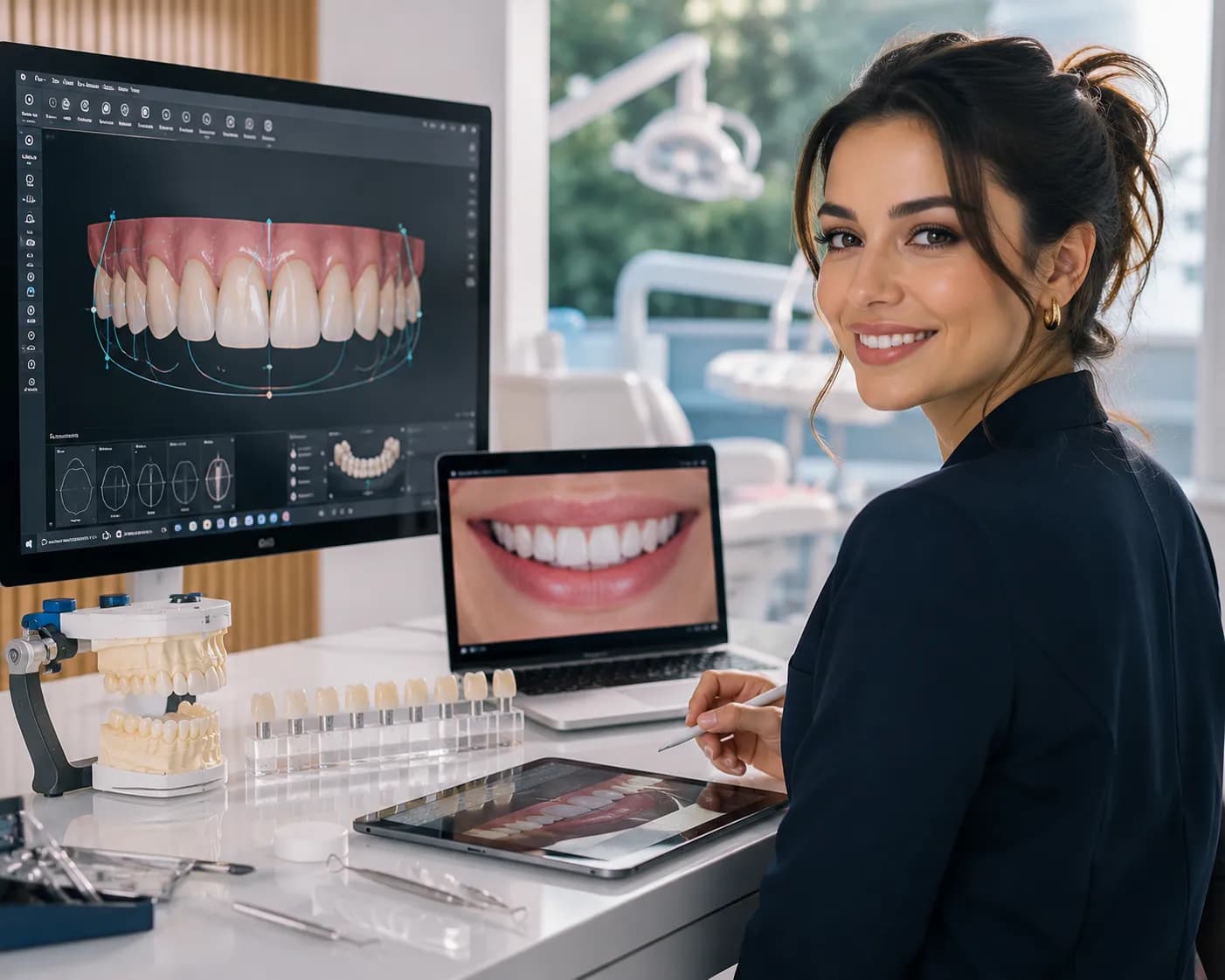
What Is Digital Smile Design?
Digital smile planning may use:
facial photographs
intraoral photographs
video
digital scans
radiographs
computer-assisted design
mock-ups
temporary prototypes
These tools can help evaluate tooth proportions and show a possible direction before irreversible treatment.
However, digital planning is not a guarantee of a specific outcome.
The final result still depends on:
biology
material properties
laboratory work
tooth preparation
bonding
bite
healing
patient maintenance
Technology should support clinical judgment rather than replace it.
What Happens During Hollywood Smile Treatment?
The process varies according to the selected procedures.
Stage 1: Online Preliminary Assessment
International patients may provide:
smile photographs
close-up dental photographs
panoramic radiographs
medical information
previous treatment reports
aesthetic concerns
This can support an initial discussion, but it does not provide a definitive diagnosis.
Stage 2: Clinical Examination
After arrival, the dentist should evaluate:
tooth decay
old restorations
gum health
bite
tooth vitality
cracks
wear
tooth position
jaw movement
smile line
hygiene
The final plan may differ from the initial online estimate.
Stage 3: Treatment of Existing Disease
Before cosmetic treatment, the patient may need:
professional cleaning
gum treatment
fillings
root canal treatment
replacement of failed restorations
orthodontics
bite stabilization
Aesthetic treatment should not conceal active disease.
Stage 4: Smile Planning
The dentist and patient discuss:
shade
tooth length
tooth shape
symmetry
natural versus highly uniform appearance
number of visible teeth
gum display
A mock-up or provisional design may help the patient evaluate the planned appearance.
Stage 5: Tooth Preparation
Preparation should follow the selected restoration and clinical need.
Veneers usually require less reduction than crowns, although every case differs.
Stage 6: Temporary Restorations
If teeth are prepared, temporary restorations may protect the teeth and provide a preview of shape and bite.
Patients should assess:
comfort
speech
tooth length
lip support
chewing
appearance
Stage 7: Final Restorations
The final ceramic restorations are evaluated for:
fit
contacts
bite
shade
shape
gum response
phonetics
They are then bonded or cemented according to the material and preparation design.
How Long Does Hollywood Smile Treatment Take?
Treatment duration depends on the procedures involved.
Possible timelines include:
whitening: one or more appointments
bonding: often one or several visits
veneers or crowns: usually multiple clinical and laboratory stages
gum treatment: healing may be required
orthodontics: several months or longer
implants: often several months including healing
A very short advertised treatment period may not reflect the full biological process.
The patient should ask whether the quoted duration includes:
examination
treatment of disease
laboratory production
temporary restorations
trial stage
adjustments
follow-up
How Much Does a Hollywood Smile Cost in Turkey?
There is no standard Hollywood Smile price because it is not one procedure.
The total cost depends on:
number of treated teeth
veneers versus crowns
ceramic material
composite bonding
whitening
gum treatment
orthodontics
root canal treatment
implants
laboratory
temporary restorations
complexity
follow-up
Prices in Turkey may be lower than in Germany, Austria, Switzerland or other European countries because operating and laboratory costs differ.
However, treatment should not be selected solely because of a low package price.
Patients should request a written plan showing:
tooth numbers
treatment type for each tooth
material
temporary restorations
additional procedures
laboratory work
total cost
conditions that may change the quotation
What Are the Risks of a Hollywood Smile?
Risks depend on the treatment.
Possible complications include:
tooth sensitivity
gum irritation
excessive tooth reduction
unnatural tooth shape
shade dissatisfaction
bite discomfort
ceramic fracture
bonding failure
gum recession
plaque retention
need for root canal treatment
replacement of restorations
mismatch with facial appearance
difficulty cleaning
irreversible loss of enamel
Aggressive preparation may increase biological risk.
This is why a smile transformation should be based on diagnosis rather than a fixed number of crowns.
Can Veneers or Crowns Last Forever?
No dental restoration should be considered permanent for life.
Longevity depends on:
material
preparation
bonding
bite
grinding
hygiene
gum health
diet
trauma
maintenance
Ceramic restorations may last many years, but they can chip, debond, wear or eventually require replacement.
Patients who grind their teeth may need a night guard.
What Happens to the Natural Teeth Under Veneers or Crowns?
The natural teeth remain underneath the restorations.
They can still develop:
decay
cracks
gum disease
root inflammation
sensitivity
structural damage
Good hygiene and regular examinations remain necessary.
Restorations do not make teeth immune to disease.
Can a Hollywood Smile Be Reversed?
Whitening is generally non-restorative and does not permanently cover the tooth.
Composite bonding may sometimes be modified or removed, although enamel can still be affected.
Veneers and crowns are usually not fully reversible once teeth have been prepared.
Patients should understand this before treatment.
Aesthetic dentistry should be approached as a long-term medical commitment rather than a temporary fashion choice.
Warning Signs of an Overly Aggressive Smile Plan
Patients should investigate further when:
healthy teeth are automatically assigned crowns
all patients receive the same number of teeth
no gum or bite examination is performed
the plan is finalized from one photograph
very white teeth are promoted as the only desirable result
risks are not discussed
alternatives are ignored
preparation is described as completely harmless
no temporary or trial stage is offered
the dentist’s identity is unclear
treatment is marketed mainly as a holiday package
Why Treatment Planning Matters More Than the Label
The phrase Hollywood Smile can make treatment sound simple.
In reality, the correct plan may involve several specialties.
A patient with healthy but stained teeth may need only whitening.
A patient with small gaps may benefit from bonding.
A patient with rotated teeth may be better suited to aligners.
A damaged tooth may need a crown.
A structurally healthy tooth may be more suitable for a veneer.
The same advertised result can therefore require completely different treatments.
Why Consider Hollywood Smile Treatment in Ankara?
Ankara offers an environment that is more strongly associated with healthcare, administration and structured treatment than with coastal tourism.
For international patients, this can support:
detailed assessment
planned clinical appointments
communication with the dental team
laboratory coordination
recovery
follow-up
treatment-focused travel
A Hollywood Smile should not be planned around sightseeing, swimming or nightlife.
If tooth preparation, gum surgery or other procedures are performed, patients may need rest, a modified diet and scheduled controls.
Treatment comes first. Tourism comes second.
Hollywood Smile Planning at DentisLife
At DentisLife in Ankara, Turkey, a Hollywood Smile is not treated as one standard package.
The clinical process focuses on:
preserving natural teeth
evaluating tooth and gum health
analysing the bite
choosing treatment tooth by tooth
discussing whitening, bonding, veneers, crowns or orthodontics
planning natural proportions
selecting appropriate materials
using digital records where indicated
creating maintainable restorations
organizing follow-up
At DentisLife, healthy teeth are not automatically treated with full crowns solely to produce a uniform appearance.
The treatment plan is based on the condition of each tooth and the patient’s long-term needs.
The International Patient Journey at DentisLife
1. Online Consultation
Patients may send photographs, radiographs, medical information and aesthetic preferences.
2. Preliminary Treatment Discussion
Possible options, estimated stages and travel requirements are discussed.
3. Clinical Examination in Ankara
The final diagnosis is established after evaluating the teeth, gums, bite and available imaging.
4. Individual Smile Planning
Shape, shade, tooth proportions and treatment alternatives are reviewed.
5. Treatment
Whitening, bonding, veneers, crowns or combined treatment is performed according to the confirmed plan.
6. Final Evaluation
The bite, speech, comfort, hygiene and appearance are checked.
7. Follow-Up
Patients receive treatment documentation, care instructions and follow-up support after returning home.
Frequently Asked Questions
Is a Hollywood Smile the same as veneers?
No.
Veneers may be part of a Hollywood Smile, but the treatment may also include whitening, bonding, orthodontics, crowns or gum treatment.
Does every Hollywood Smile require crowns?
No.
Crowns are generally more suitable for structurally damaged or weakened teeth. Healthy teeth should be assessed for more conservative alternatives.
Are teeth always shaved for veneers?
Some preparation is often required, but the amount varies.
No-prep veneers are suitable only for selected cases.
Is whitening enough for a Hollywood Smile?
It may be enough when the main concern is colour and tooth shape and alignment are acceptable.
How many teeth are usually treated?
There is no universal number.
The decision depends on how many teeth are visible when smiling, the condition of each tooth and the desired result.
Can I choose the whitest shade?
You can discuss very bright shades, but the dentist should explain how colour relates to skin tone, facial appearance, translucency and natural aesthetics.
Are veneers suitable for unhealthy teeth?
No. Existing decay, gum disease or structural problems should be treated first. The ADA notes that covering unhealthy teeth with veneers may worsen underlying dental problems.
Can crowns and veneers be whitened later?
No. Whitening affects natural teeth, not existing ceramic crowns or veneers.
How do I choose a clinic for a Hollywood Smile in Turkey?
Check the clinic’s authorization, dentist qualifications, treatment plan, tooth-preservation approach, materials, laboratory process and follow-up policy.
CTAA natural Hollywood Smile should be designed around your facial features, dental health and long-term comfort—not a standard number of crowns.
International patients considering treatment at DentisLife in Ankara, Turkey, can request an online preliminary consultation before travelling.
Photographs, radiographs and treatment expectations can be reviewed to discuss possible options. The definitive plan is confirmed after an in-person clinical examination.
International Health Tourism Authorization CertificateDentisLife holds the International Health Tourism Authorization Certificate and is listed among healthcare providers authorized by the Republic of Turkey Ministry of Health.
The authorization confirms that the clinic is officially permitted to provide healthcare services to international patients within the applicable national system.
For international patients, this supports:
regulated international patient processes
documented clinical and administrative procedures
transparent treatment organization
official authorization
defined healthcare standards
The authorization does not guarantee an individual aesthetic or medical result. Treatment outcomes depend on diagnosis, tooth condition, clinical planning, materials, patient cooperation and follow-up.