Full Mouth All-on-4 vs All-on-6 Implants: Which Option Is Better?
For patients who have lost most or all of their teeth, full-mouth dental implants can completely restore function, aesthetics, and quality of life.
Two of the most common solutions are:
All-on-4 implants
All-on-6 implants
Both systems are designed to support a fixed full-arch prosthesis, but they differ in stability, force distribution, surgical planning, and long-term biomechanics.
Understanding these differences is important before choosing the right treatment.
What Is the All-on-4 System?
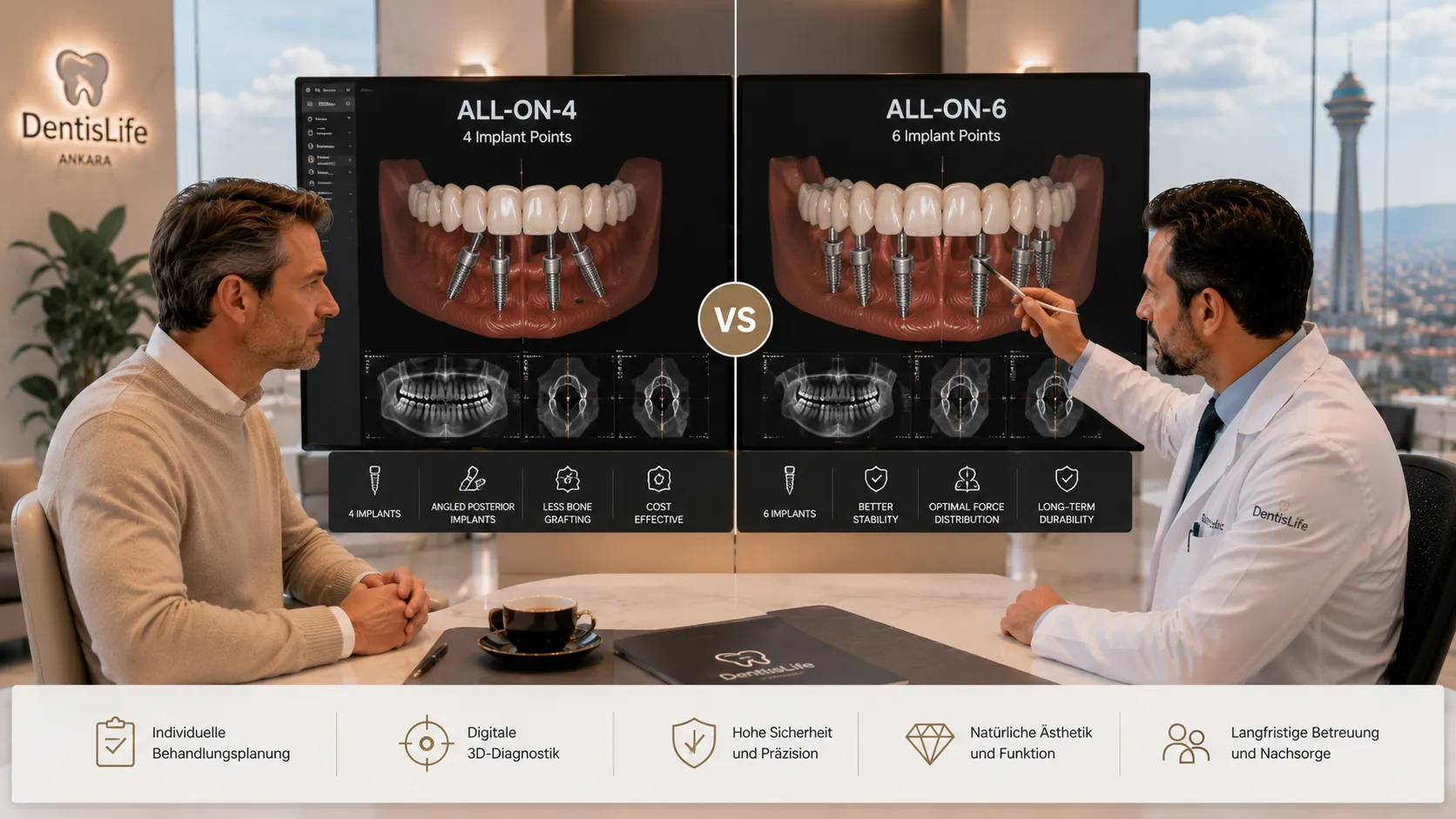
The All-on-4 concept uses four strategically placed implants to support a full arch of fixed teeth.
Typically:
Two implants are placed vertically in the front
Two implants are angled in the back
This angled placement helps maximize available bone and may reduce the need for bone grafting.
Advantages of All-on-4
Fewer implants required
Often lower treatment cost
Shorter surgery time
Suitable for patients with moderate bone loss
Faster treatment workflow in some cases
Because fewer implants are used, All-on-4 is often chosen for patients looking for a more cost-effective full-mouth solution.
What Is the All-on-6 System?
All-on-6 uses six implants instead of four to support the full prosthetic bridge.
The additional implants improve:
Force distribution
Mechanical stability
Long-term load management
This system is often recommended for younger patients, patients with stronger bite forces, or cases where additional support is beneficial.
Advantages of All-on-6
Increased stability
Better stress distribution
Reduced load on individual implants
Higher long-term biomechanical support
Often more natural force balance
For many patients, All-on-6 offers greater long-term comfort and structural security.
Which System Is More Stable?
In general, All-on-6 provides higher overall stability because chewing forces are distributed across more implants.
This may reduce long-term mechanical stress and potentially improve durability over many years.
However, this does not automatically mean that All-on-4 is unsafe or ineffective.
When properly planned, both systems can achieve highly successful long-term outcomes.
The ideal solution depends on:
Bone density
Jaw anatomy
Bite force
General health
Patient expectations
Cost Difference Between All-on-4 and All-on-6
Because All-on-6 uses more implants and materials, treatment costs are usually higher.
Average international treatment costs:
Germany
All-on-4: €8,000 – €15,000 per jaw
All-on-6: €10,000 – €18,000 per jaw
Turkey
All-on-4: €3,500 – €6,500 per jaw
All-on-6: €4,500 – €8,000 per jaw
Prices vary depending on implant brands, prosthetic materials, and clinic standards.
Is Bone Grafting Necessary?
One advantage of All-on-4 is that angled posterior implants may reduce the need for bone grafting.
However, every patient is different.
Some cases still require:
Bone augmentation
Sinus lifting
Soft tissue management
A detailed CBCT scan and digital planning are essential before deciding on the treatment approach.
Healing and Recovery
Both systems require healing and adaptation phases.
Most patients can return to normal daily activities within a few days, but complete osseointegration usually takes several months.
During healing:
Smoking should be avoided
Alcohol consumption should be minimized
Soft diet may be required temporarily
Follow-up visits are important
Proper aftercare is critical for long-term implant success.
Why Treatment Planning Matters More Than Marketing
In highly touristic areas, full-mouth treatments are sometimes promoted as quick cosmetic solutions.
However, successful implant rehabilitation requires:
Precise diagnostics
Correct implant positioning
Bite analysis
Long-term biomechanical planning
The quality of planning is often more important than the number of implants used.
Why Ankara Offers a More Medical-Focused Approach
Unlike heavily tourism-oriented destinations, Ankara provides a more clinical and healthcare-focused environment for complex implant treatments.
This allows clinics to prioritize:
Medical quality
Detailed diagnostics
Long-term stability
Structured follow-up care
For full-mouth rehabilitation cases, this approach is especially important.
All-on-4 and All-on-6 Treatments at DentisLife in Ankara
At DentisLife in Ankara, every full-mouth implant case is individually planned using advanced digital diagnostics and evidence-based treatment protocols.
Our approach focuses on:
Functional stability
Natural aesthetics
Long-term implant success
Personalized treatment planning
We evaluate each patient carefully to determine whether All-on-4 or All-on-6 is the better long-term solution.
Your Dental Journey with DentisLife
We guide international patients through every stage of treatment:
Online consultation
Digital planning and diagnostics
Treatment in Ankara
Long-term follow-up and support
This structured system helps create safer and more predictable outcomes.
FAQ
Is All-on-6 better than All-on-4?
Not always. The best option depends on bone quality, anatomy, and long-term goals.
Is All-on-4 safe?
Yes, when properly planned and performed by experienced implant clinicians.
Which option lasts longer?
Both can last many years, but All-on-6 may provide better long-term force distribution.
Is treatment painful?
Most patients report manageable discomfort thanks to modern surgical techniques and anesthesia.
CTA
If you are considering full-mouth dental implants and want a medically focused, long-term solution, DentisLife in Ankara is here to guide you.
Our team provides personalized implant planning designed for stability, aesthetics, and long-term success.
Contact us today to receive your customized treatment plan.
International Health Tourism Authorization Certificate
DentisLife is officially authorized by the Republic of Turkey Ministry of Health and holds the International Health Tourism Authorization Certificate.
This certification confirms that our clinic meets official standards for international patient care, treatment quality, and medical safety protocols.
For our patients, this means:
Safe medical environment
Verified clinical standards
Transparent treatment systems
Related Articles